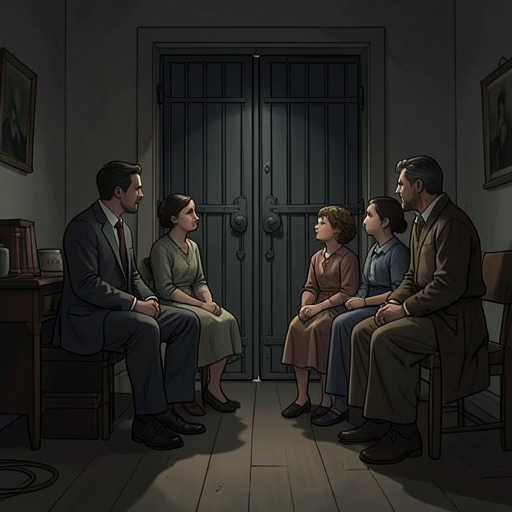
Surveillance and threats against the Barber family during the trial
Defending JacobSurveillance and threats against the Barber family during the trial turn the family’s visibility into a source of danger. An unidentified car repeatedly watches their home, and a written death threat appears at the courthouse; although the evidence offers a possible visual link between the car and an older man seen later, it does not confirm the watcher’s identity or prove who left the note.
The Family Under Public Pressure
The surveillance unfolds as the murder trial makes the Barber family a subject of public attention. In his opening statement, Neal Logiudice presents the killing of Ben Rifkin as a story the jury must understand: a boy with a lethal temper, pushed until he “snapped.” He acknowledges that Ben teased Jacob, while characterizing the taunting as ordinary school behavior, and describes the central question of motive as unresolved. The prosecution’s confident narrative thus sits alongside the narrator’s account of its gaps, including Logiudice’s reliance on theories and probabilities.
That public account has a private counterpoint in the family’s encounter with the Rifkins at a market. Dan Rifkin and his wife Joan face the Barbers; the narrator observes the painful arithmetic of the meeting: three people in one family, two in the other, with one son present and another dead. In that moment, Jacob’s continued existence seems offensive to the grieving parents. The scene shows how the trial’s competing positions are also relations between families marked by loss, suspicion, and an unavoidable public encounter.
The Car Outside the House
One evening, Laurie notices a car idling across the street, two houses away, and complains about its engine. From the window, the narrator sees a large sedan in a dark area between streetlights; the driver remains indistinguishable, except for a small amber glow as someone smokes. The family initially treats it as an inconvenience, and the narrator suggests the driver may simply be waiting for someone.
Later, while taking out the garbage and recycling, the narrator notices the car again, now across the street in the opposite direction. Its engine and lights come on, revealing that it has no front license plate. As the narrator approaches, it backs away, turns at the next cross street, and drives off. The movement makes the earlier sighting harder to dismiss, though the darkness prevents him from identifying the car or its driver.
The car returns once more while the narrator and Jacob watch television. This time the narrator goes through a neighbor’s backyard and identifies it as a Lincoln Town Car with Massachusetts plate 75K S82. Its interior is dark. He considers confronting the driver, but the encounter supplies no identification or explanation. He later gives the registration and vehicle description to Paul Duffy, who calls it in, turning a suspicion at the family home into information passed to law enforcement.
A Threat at the Courthouse
After a day at court, the narrator finds a quarter-folded piece of paper under the windshield wiper of the family’s car in a garage a block from the courthouse. It carries two explicit threats: “JUDGMENT DAY IS COMING” and “MURDERER, YOU DIE.” The note changes the meaning of the family’s exposure: this is no longer only the unease of an unknown car nearby, but a written threat directed at them in connection with the murder case.
Jonathan takes the note and says he will report it to Cambridge police. Laurie asks whether that is all they can do; the narrator suggests notifying Newton police as well and considers having a cruiser stationed near their home. His comment that the world is full of lunatics conveys fear without resolving whether the threats are related to the car or who is behind them.
Possible Link, Uncertain Identity
In the garage, the narrator notices an older man, perhaps near seventy, wearing a jacket, golf shirt, and scally cap. The man lights a cigarette; the flare and glowing tip recall the small light the narrator saw inside the parked car outside the house. The resemblance prompts the narrator to wonder whether the man is the same person who occupied the Lincoln, but the scene does not establish that they are one and the same. Their eyes meet briefly, and the man walks away. The narrator’s own account leaves room for another explanation: perhaps the man had only stopped to light his cigarette.
The episodes therefore accumulate as a pattern without becoming a solved investigation. The Town Car’s repeated appearances, its registration, the courthouse note, and the cigarette-light association all raise the possibility of coordinated surveillance and intimidation, but none identifies a perpetrator. That uncertainty parallels the trial’s broader struggle to turn fragments into a coherent account. The family receives no conclusive answer about who watched them or wrote the threat, even as the danger deepens their sense that the case extends beyond the courtroom.